Share It On:
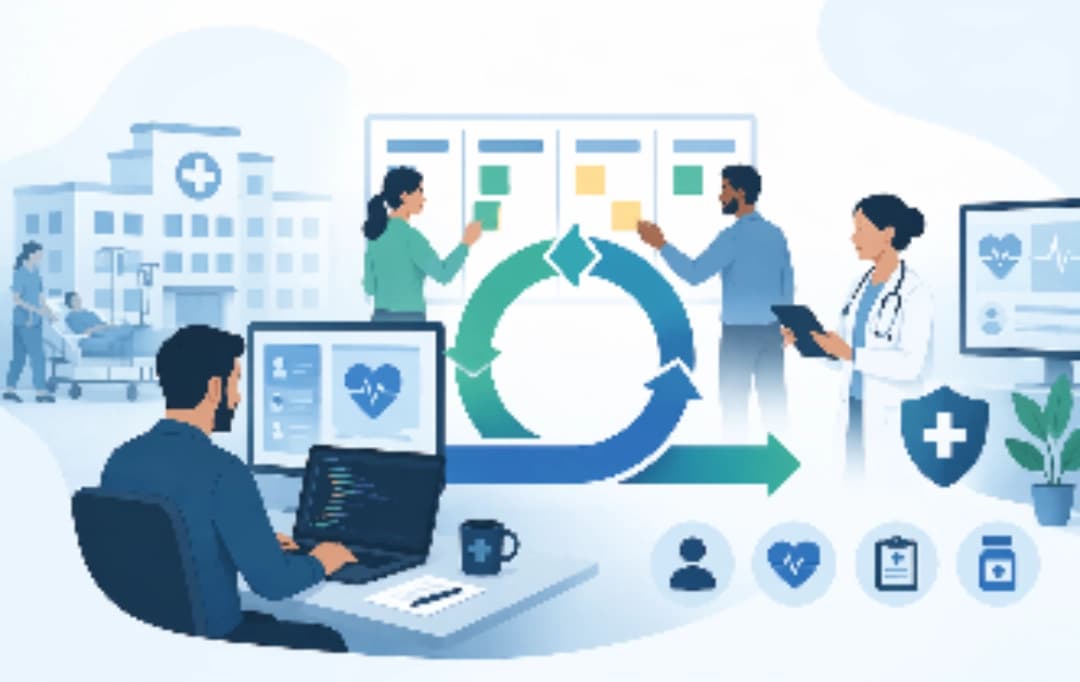 Don't let rigid frameworks kill your ROI. Strategic Agile frameworks in healthcare software development allow founders to launch MVPs much faster, securing market share in a global industry projected to reach USD 1.16 trillion by 2031.
In 2026, building healthcare software requires a systematic approach. When regulatory shifts like the latest FDA or HIPAA-compliant updates hit the development mid-cycle, rigid development structures begin to break down, leaving you with unstructured code and drained capital.
The pivot to Agile frameworks in healthcare software development is the only strategic move left. It transforms software from a static product into a living entity that evolves through iterative Sprints and real-time clinician feedback. With the healthcare IT market surging toward USD 650 billion this year, agility is your primary defence against becoming clinically irrelevant.
By integrating compliance into the development, you aren't just coding; you’re building a scalable, audit-ready ecosystem. This editorial breaks down how to master the software development languages and these frameworks to achieve rapid ROI without compromising patient safety.
What Are Agile Frameworks in Healthcare Software Development?
The Agile methodology in healthcare is a philosophy that prioritizes functional software delivery over static documentation. It is a disciplined, iterative approach to engineering that balances fast innovation with the uncompromising safety standards of a clinical environment.
In the medical domain, Agile is the practice of breaking down massive, complex systems, such as an Electronic Health Record (EHR) or a diagnostic AI, into manageable, shippable increments called Sprints.
Unlike general software, healthcare software development agile cycles must bake in regulatory checkpoints at the end of every iteration. This ensures that privacy standards like HIPAA (in the US) or GDPR (in Europe) are not bolted on at the end but are part of the software’s DNA.

Cost Structure: Decoding the Investment Layers of Agile Healthcare Projects
Navigating the budget of Agile frameworks in healthcare software development requires a shift from fixed-bid thinking to value-based investment. In a traditional setup, you pay for a list of features; in an Agile model, you invest in a dedicated capacity to solve clinical problems iteratively.
The total software development cost is influenced by three primary drivers: the technical complexity of the medical use case, the depth of regulatory scrutiny required, and the location of your engineering hub.
Estimated Investment by Healthcare Software Category
| Software Category | Feature Complexity | Budget (USD) | Launch Timeline (MVP) |
|---|---|---|---|
| Patient Engagement Apps | Medium (Scheduling, Chat, Reminders) | $45,000 – $85,000 | 3 – 5 Months |
| Telemedicine Platforms | High (Video, EHR Sync, Billing) | $75,000 – $160,000 | 4 – 7 Months |
| Enterprise EHR/EMR | Very High (Interoperability, Data Vaults) | $200,000 – $550,000+ | 9 – 14 Months |
| AI Diagnostic Tools | Extreme (ML Models, FDA Class II/III) | $250,000 – $750,000+ | 12 – 18 Months |
Regional Cost and Compliance Maturity Matrix
| Region | Hourly Rate (USD) | Compliance Maturity | Market Strength |
|---|---|---|---|
| USA | $120 – $210 | Elite | Direct expertise in HIPAA, FDA Class II/III, and HITRUST |
| India | $35 – $75 | High | Massive talent pool with deep experience in working for global HealthTech giants |
| UK | $90 – $160 | High | Specialists in GDPR and NHS Digital Standards (DCB0129/0160) |
| UAE | $80 – $140 | Emerging | Rapidly maturing regulatory landscape (DHA/MOHAP) |
Pro-Tip for Founders: To optimize your spend, many successful startups use a hybrid model. They keep the Product Owner and Lead Architect in high-maturity regions (like the USA or UK) to handle regulatory strategy, while utilizing software development companies in India for the heavy-lifting of iterative sprint execution.
Key Agile Frameworks for Healthcare Software
Not all Agile models fit every medical project. You have to choose the right Agile framework for healthcare software, depending on team size, project complexity, and the level of regulatory scrutiny. The four primary frameworks that dominate the software development landscape offer a different roadmap for navigating the major complexities of medical software engineering.
1. Scrum in Healthcare Software Development
Scrum is the most popular framework because it thrives on clear structure and accountability. In a clinical setting, it transforms the Software Development Life Cycle (SDLC) from a marathon into a series of highly focused sprints. The following points highlight the specific roles that define the application of Scrum in a healthcare context:
| The Clinical Product Owner (PO) | The Scrum Master as a Regulatory Liaison | Medical-Grade Sprints | Precision via Story Point Estimation |
|---|---|---|---|
| Acts as the bridge between software engineering and the medical board, ensuring the backlog prioritizes safety-critical features like patient data encryption. | Protects the team from friction while ensuring the Definition of Done (DoD) includes mandatory software risk analysis and audit trails with ISO 13485 standards. | Fixed 2 to 4 week cycles that deliver functional, compliant increments, such as a FHIR-ready API for a new EHR module. | Utilizing story points in Agile estimation to ensure high-risk medical logic, such as automated dosing, is never rushed. |
2. Kanban and Lean Approaches in Medical Projects
When a project shifts from initial feature development to long-term operational maintenance, Kanban’s continuous flow becomes a strategic asset. These applications demonstrate how Kanban and Lean principles are utilized to optimize live medical software environments:
| Clinical Workflow Visibility | Emergency Bug Management | Lean Waste Reduction |
|---|---|---|
| Digital boards track every task across specific columns, such as Security Audit and Regulatory Sign-off, to identify bottlenecks instantly. | Provides a fast-track lane to push critical, life-saving patches to live systems without waiting for a sprint cycle to end. | Eliminates feature bloat (non-essential code), focusing the development budget strictly on features that improve patient outcomes. |
3. Scaled Agile Framework (SAFe) for Large-Scale Hospital Systems
When a project involves 50+ developers working on a massive interconnected hospital network, SAFe is the go-to. It synchronizes multiple Scrum teams through Agile Release Trains (ARTs), ensuring that the billing department's software remains compatible with the pathology lab's database updates. The following points demonstrate its application in massive healthcare ecosystems:
| Agile Release Trains (ARTs) | Unified Enterprise Compliance | Portfolio Management |
|---|---|---|
| Synchronizes dozens of squads, such as billing, pharmacy, and radiology, to ensure cross-platform updates don't break clinical interoperability. | Implements a consistent software development checklist across all departments, ensuring the entire organization is audit-ready at scale. | Helps hospital executives align their digital transformation budget with long-term clinical and financial ROI. |
4. Hybrid and Tailored Agile Models for Healthcare
Strategic flexibility in HealthTech often means knowing when to be iterative and when to follow a linear path. Many firms confuse Agile vs Waterfall in healthcare software development and have begun implementing Water-Scrum-Fall to balance the flexibility of coding with the rigidity of the law. Here is how organizations apply tailored hybrid models to balance agility with regulatory rigor:
| Waterfall Pre-Planning | Agile Core Execution | Integrated V-Model Validation |
|---|---|---|
| Used for high-level regulatory filings and hardware procurement that require fixed timelines and documentation before coding begins. | The software itself is built iteratively, allowing the UI and feature logic to evolve based on real-time feedback from nurses and physicians. | Merges the formal verification required for ISO 13485 with the rapid construction phase of a standard Agile cycle. |
Benefits of Agile in Healthcare Software Development
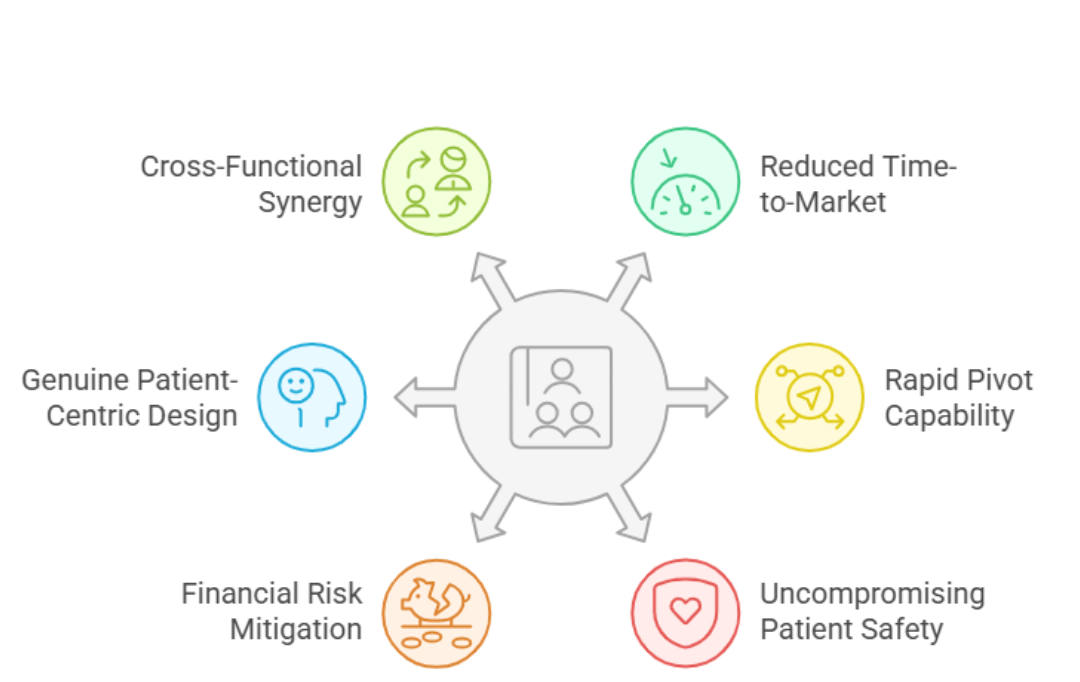
Adopting an iterative model isn't just about moving faster; it’s about surviving an industry where a single code error or a missed compliance update can lead to legal liability or clinical failure. By ditching the set-it-and-forget-it Waterfall mentality, leaders can reap the following benefits of Agile practices in healthcare software development:
1. Reduction in Time-to-Market
By prioritising a lean MVP (Minimum Viable Product), HealthTech firms can ship a core, HIPAA-ready application in roughly 90 to 120 days. It allows you to secure early hospital contracts and start generating ROI while your competitors are still stuck in a two-year planning phase.
2. Rapid Pivot Capability for Regulatory Shifts
Regulatory requirements such as GDPR and new FDA mandates in healthcare are moving targets. Traditional models shatter when these rules change mid-cycle. However, Agile software development in healthcare gives you the flexibility to reroute your development roadmap in the very next sprint, ensuring your product is never obsolete before it even launches.
3. Uncompromising Patient Safety via Continuous QA
Rather than treating testing as a final check-the-box activity, Agile implements it into the daily workflow. By integrating AI in software testing, teams can run automated simulations on synthetic patient data. It identifies potential failures long before, ensuring a zero-fail performance in high-pressure clinical environments.
4. Financial Risk Mitigation and Sunk Cost Avoidance
One of the most underrated benefits of Agile in healthcare software is the downfall of the sunk cost fallacy. Instead of spending millions on a feature that surgeons eventually find unusable, you build a functional prototype, test it in the field, and refine it within weeks. This iterative loop keeps your capital focused on high-utility features that drive patient outcomes.
5. Genuine Patient-Centric Design
Most medical software fails because of poor UI friction that leads to clinician burnout. Agile forces developers to leave the tech bubble and collaborate directly with practitioners. If a dashboard is confusing in an emergency room setting, it gets caught and redesigned in the first month, ensuring the tool actually fits the medical workflow it was built to serve. This is the primary reason why agile in the healthcare industry is gaining traction.
6. Enhanced Cross-Functional Synergy
Agility destroys the silos between your software engineers and your clinical advisory board. By bringing medical subject matter experts into daily stand-ups, the healthcare software development process stays anchored in clinical reality. This collaboration is essential for building complex types of healthcare software that require both high-level coding and deep medical expertise.

Strategic Agile Methodology Implementation in Healthcare
To get Agile adoption in the healthcare industry right, you have to stop thinking like a generic tech startup and start thinking like a medical engineer. You can't just move fast and break things when patient data and clinical safety are on the line. Instead, the rollout is a disciplined, three-part journey designed to satisfy both the developers’ need for speed and the regulators’ demand for a paper trail.
Here is how we break down the transition from a concept to a live, clinical-grade product:
Phase 1: Requirement Gathering & Compliance Mapping

We start by defining the compliance non-negotiables. In this stage, the team audits the project against software development trends and healthcare standards such as HIPAA, SOC 2, and ISO 13485. They also audit if the developer is following a software development checklist. These aren't just documents; they are integrated into the DoD for every task. No feature moves to production unless its audit trail is fully verified and documented.
Phase 2: Iterative Prototyping and User Testing

This phase focuses on validated learning. We build high-fidelity, clickable prototypes to test the logic of patient data flows and diagnostic alerts. By involving actual healthcare providers early in the Software Development Life Cycle (SDLC), we ensure that the software solves real clinical pain points rather than purely hypothetical ones.
Phase 3: Deployment and Post-Launch Optimization

The launch is merely the beginning of the journey. Using Agile methodology, we transition into a cycle of continuous improvement and Post-Market Surveillance (PMS). By leveraging DevOps in software engineering, we push regular, secure updates that harden the system against new security threats and refine the user experience based on real-world data from the field.
Also Read: Healthcare Software Development Guide
Future Outlook: The Evolution of Agile Practices in Healthcare Software Development
Looking toward 2026 and beyond, the integration of Generative AI and Agentic AI into the Software Development Life Cycle (SDLC) will supercharge Agile. We are entering a phase of value-based development, where software success is measured by clinical outcomes, such as reduction in patient wait times, rather than just uptime.
As Artificial Intelligence in software development continues to scale, we expect Agile teams to use predictive analytics to predict where bugs will occur even before a sprint starts. This level of foresight will be crucial as healthcare moves toward personalized medicine and remote patient monitoring.
Finding engineers who understand the Agile speed and medical-grade rigor is a challenge. MobileAppDaily maintains a curated network of elite development partners specializing in Agile frameworks in healthcare software development, ensuring your project is handled by experts who know HIPAA as well as they know Python.
Final Verdict: Choosing the Right Path for Your HealthTech Product
Transitioning to Agile frameworks in healthcare software development is a survival strategy. For healthcare founders and hospital administrators, the path forward requires a balance of courage and discipline. It takes courage to move away from fixed-scope contracts and discipline to ensure that every sprint remains audit-ready. Evaluate your current development speed and compliance requirements today. If your software can't perform in a month, it's time to shift to a framework that actually can.
Frequently Asked Questions
What is the best Agile framework for healthcare software?
There is no perfect one, but Scrum in software development is usually the top choice for building new products because it provides a steady rhythm. If you are handling a live platform with urgent bugs, Kanban is better for handling that continuous flow.
How does Agile ensure compliance in regulated healthcare environments?
Agile ensures compliance by moving it to the front of the line. Instead of doing a big audit at the end, every small update must meet DoD criteria, which include security checks and documentation. This keeps you audit-ready throughout the Software Development Life Cycle (SDLC).
Can Agile be scaled for large hospital systems?
Absolutely. The Scaled Agile Framework (SAFe) is designed for this exact scenario. It helps dozens of teams, such as pharmacy, billing, and radiology, stay in sync so that a change in one area doesn't break the software in another.
What are the first steps for Agile adoption in a healthcare organization?
Start by training your stakeholders. You need your clinical and legal teams to understand that they will be involved in every sprint. Then, pick a small, non-critical project to pilot the implementation of Agile methodology in healthcare before rolling it out across the enterprise.
Is patient data safe during Agile development cycles?
Yes. By using the best encryption software tools and integrating security testing into the DoD, Agile teams catch vulnerabilities much faster than traditional teams. Security becomes a continuous process rather than a final check.
How do you handle Story Points in medical projects?
In Agile estimation, medical teams assign higher story points to tasks with high regulatory or safety risks. This ensures the team doesn't underestimate the time needed for the deep testing and validation required for clinical software.
Can I hire external teams for Agile healthcare projects?
Yes, but you need specialists. Look for healthcare software development companies that have a proven track record with HIPAA and ISO standards. They should be able to show you how they integrate compliance into their specific Agile workflow.

Uncover executable insights, extensive research, and expert opinions in one place.
Related Content