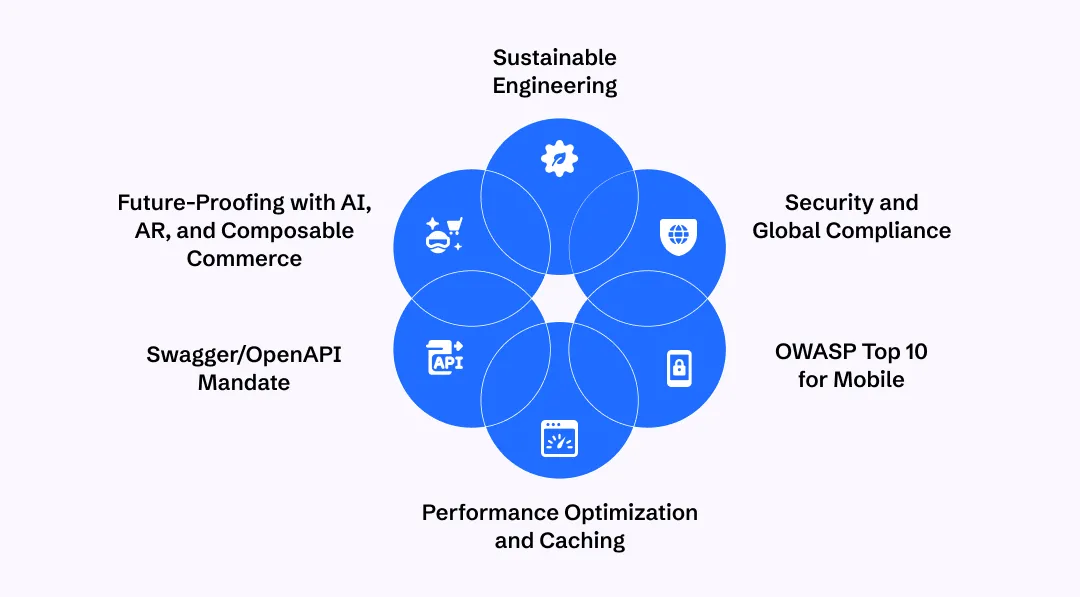
- 1. Sustainable Engineering: The Rise of "Green Ops"
- 2. Security and Global Compliance (GDPR, PCI DSS, and Beyond)
- 3. Addressing the OWASP Top 10 for Mobile
- 4. Advanced Performance Optimization and Caching
- 5. Documentation: The Swagger/OpenAPI Mandate
- 6. Future-Proofing with AI, AR, and Composable Commerce
 Share It On:
 Your essential roadmap to mobile app backend development, covering the architectural foundations and technologies necessary to deliver a seamless user experience at scale.
We have moved far beyond the days of simple servers. We are now in an "experience economy" where your backend is the silent architect of every personalized notification and secure transaction. According to Fortune Business Insights, the mobile application development platform market is set to climb from $375.18 billion in 2026 to $1112.36 billion in 2034. That capital isn't flowing into better aesthetics; it’s being poured into the robust mobile app backend development required to meet the growing demands of today's users.
For any leader, figuring out how to build a backend for any app isn't just a technical hurdle to clear; it’s a strategic play. When you look at the broader mobile app development process, the backend is where your greatest scalability potential and your most dangerous technical debt reside. If the foundation of the app is weak, it won't just lag; it will not reach the right person and give you the promised growth. Think of this mobile backend development guide as your roadmap for building an infrastructure that is not just functional today, but strong enough to handle whatever the next decade of technology throws at it.
What is Backend Development?
It is the server-side of an application. While the frontend is what the user touches, the backend is where the logic resides. It consists of the server that hosts the application, the database that stores information, and the APIs (Application Programming Interfaces) that act as the bridge between the two.
When we talk about backend development for mobile apps, we are dealing with an extra layer of complexity. It needs to stay fast whether a user is on a high-speed fiber connection or an unstable 4G signal in a moving train. If the backend for mobile applications isn't optimized for these varying conditions, the most beautiful frontend in the world will still feel broken.

Four Core Components of Mobile App Backend Architecture
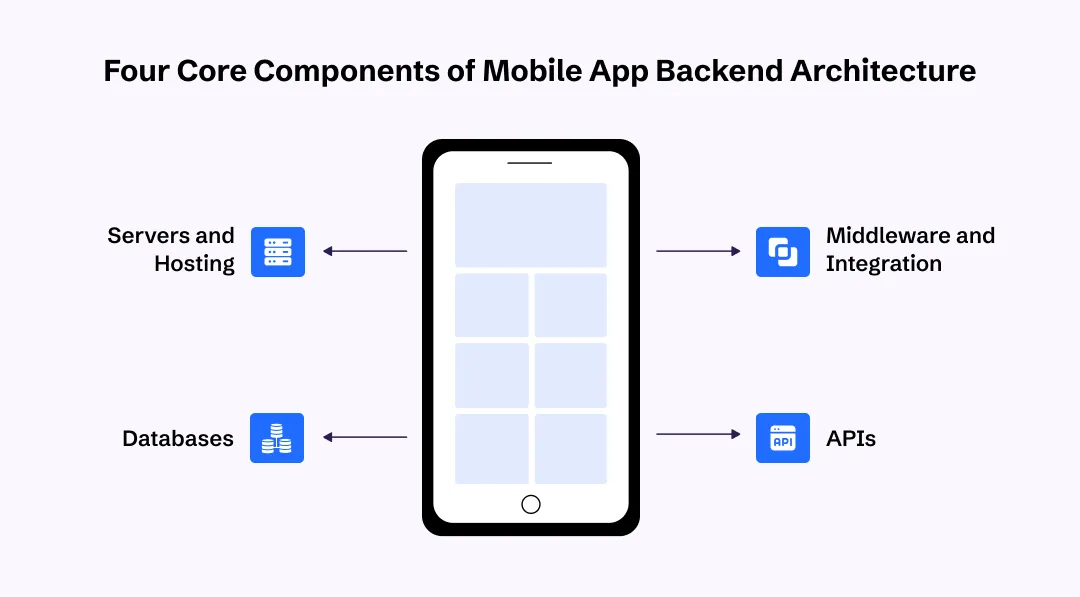
In a world where technology is transforming how we view apps, a strong, polished architecture is what businesses really need today. Below are the four core components of the mobile app backend architecture to give you a broader idea:
1. Servers and Hosting: Finding the Right Home
Deciding where your data actually lives is the heavy-lifting phase of learning how to build a backend for a mobile app. You have basically got two paths here. There’s the old-school on-premise route, and then there’s the gold standard: cloud hosting. Most leaders today lean toward a cloud-driven mobile application model using giants like AWS, Google Cloud, or Azure. The real beauty here is the "pay-as-you-go" flexibility.
2. Databases: The Vault for Your Digital Currency
In the backend development process, choosing between SQL and NoSQL is one of the most consequential decisions you have to make. It dictates how your app survives under pressure. If you are handling payments or user logins, SQL is the standard. It uses strict rules to keep data accurate. NoSQL, however, thrives on the messy stuff. It handles social feeds or real-time logs with ease.
3. Middleware and Integration Layers
Sometimes, the frontend and the database need a translator; that’s where middleware comes in. This layer handles tasks such as authentication, logging, and data transformation. It’s the glue that allows you to build an app from scratch that can still talk to legacy enterprise systems or third-party tools. For a CTO, middleware is the secret to maintaining a clean, modular architecture that doesn't become a tangled mess of unstructured code as you add more features.
4. APIs: Building the Bridges
APIs are the high-speed messengers of your digital world. They are the absolute lifeline of any backend architecture for mobile applications. It acts as the bridge that lets your frontend talk to your server. If these bridges are narrow or poorly built, the user experience feels sluggish, no matter how fast the device is. To get this right, you need to ensure your endpoints are not just fast but incredibly secure. Without high-performing APIs for mobile app development, your frontend looks great, but it won't go anywhere.
Mobile App Backend Development Models
There is no single model for developing the backend for your mobile app. Depending on the timeline, your appetite for risk, and your long-term budget, the path you choose will dictate how fast you can innovate. Explore the three core models mentioned below that stay with you from the start:
1. Custom Backend Development: The Personalized Approach

Think of this as building your dream home from the ground up. You aren't buying a pre-packaged solution; you’re writing every line of logic using high-performance languages like Node.js, Python, or Go. This is the ultimate play for companies developing an amazing app that requires highly specific, proprietary features that a template cannot handle.
You own the code, you define the security, and you aren't paying a per-user tax to a third-party provider. However, this model requires a high level of expertise and a longer lead time. It is perfect for developing mobile applications for businesses where the app is the product, and you need the flexibility to pivot your logic at a moment's notice.
2. Backend as a Service (BaaS): The Fast-Track Accelerator

If you are a startup founder with a "ship-it-yesterday" mentality, BaaS is your best friend. Platforms like Firebase or AWS Amplify act as a plug-and-play mobile backend development guide, providing ready-made modules for the boring but essential stuff: user authentication, database management, and push notifications.
According to Mordor Intelligence, the mobile backend-as-a-service (MBaaS) market is estimated at $18.33 billion by 2031. It’s a "pay-as-you-go" dream for getting an MVP to market, though you do have to be mindful of vendor lock-in as you grow.
3. Composable Architecture: The 2026 Gold Standard

We have officially entered the era of the "un-monolith," where single-service architecture no longer serves its purpose. Instead of building one giant complex backend, the 2026 standard is Composable Architecture. This approach treats your mobile app backend architecture like a set of independent Lego blocks.
One service handles your payments (like Stripe), another handles your search (like Algolia), and a third handles your AI logic. If one block breaks, the rest of your app stays. When you are learning how to choose a mobile app development company, make sure the development team understands this modular approach.

How to Build a Backend for a Mobile App: A Step-by-Step Process
Building a solid backend is less about the act of coding and more about the art of orchestration. It’s a marathon where the choices you make in the first mile determine whether you’ll scale to millions or crash during your first traffic spike.
To get this right in the first place, you need a polished and well-organized mobile backend development guide that balances speed-to-market with the technical integrity required for long-term app survival.
Phase 1: Requirements Analysis and Modeling
Before anyone starts typing code, you have to map out the DNA of your data. If you are planning to build an app from scratch, first define your "Source of Truth." This isn't just about where you will store user names; it’s about modeling how data will travel, transform, and trigger actions across your system. This stage is the bedrock of your backend infrastructure for apps; get the schema wrong here, and you’ll be paying for it in technical debt for years to come.
Phase 2: Defining the Tech Stack and Architecture
Your tech stack decisions reflect your hiring and maintenance costs, and your ability to innovate. Are you going to move towards Python for mobile app development to utilize its massive libraries for machine learning? Or is the high-concurrency, event-driven nature of Node.js a better fit for your real-time needs? Always remember that the best backend technology for mobile apps is the one that aligns with your business logic.
Phase 3: Core Logic and API Orchestration
Building the server-side logic and APIs that serve as the universal translators between your data and your users is the heartbeat of the backend development process. If you are looking at specialized features like real-time location tracking or implementing artificial intelligence in an app, you might find it more strategic and reasonable to outsource mobile app developers. This allows your internal team to focus on the company goals, while the developers will handle the complex and standardized infrastructure.
Also Read: How To Master API Development
Phase 4: Fortifying Security and Regulatory Compliance
In the 2026 digital landscape, security is your brand's foundation, not an optional add-on. You need to be thinking about "Zero Trust" protocols, making sure every request is verified through OAuth 2.0 and every bit of data is shielded by modern encryption. Beyond the tech, you have to navigate the legal minefields of GDPR or CCPA. Staying fluent in mobile app development terminologies is essential here to ensure your backend is a fortress that protects both your users and your stakeholders.
Phase 5: Deployment, CI/CD, and Live Monitoring
The go-live button is actually the starting phase of mobile app deployment. A modern backend for mobile applications relies on CI/CD pipelines to push updates and patches without the user ever seeing a "down for maintenance" screen. Once you are in the go-live process, the focus shifts entirely to performance metrics like latency and error rates. This is a vital part of the broader mobile app development process, ensuring that you can identify and squash performance bottlenecks before they turn into 1-star reviews.
2026 Cost Estimation for Mobile App Backend Infrastructure
In 2026, understanding the mobile app development cost is no longer just about the initial build. It’s about the total cost of ownership (TCO), including maintenance, cloud resources, and the specialized talent required to manage your mobile app backend architecture.
Below is a comprehensive breakdown of the typical cost structures based on the complexity and the technology stack chosen.
| Backend Model | Price Range (USD) | Primary Tech Stack | Best For | What’s Included? |
|---|---|---|---|---|
| BaaS (Backend as a Service) | $5,000 – $15,000 (Initial Setup) | Firebase, AWS Amplify, Supabase | Startups, MVPs, and rapid prototyping | Ready-made auth, database hosting, push notifications, and basic cloud functions |
| Custom Monolithic Backend | $20,000 – $50,000 | Node.js (Express), Python (Django), PostgreSQL | Content-driven apps, medium-scale enterprise tools | Custom API development, complex business logic, dedicated server management, and basic security |
| Microservices / Composable | $60,000 – $150,000+ | Go (Golang), Java (Spring Boot), Kubernetes, GraphQL | High-traffic platforms, Fintech, and global E-commerce | Distributed databases, service mesh, advanced CI/CD pipelines, and high-availability orchestration |
| AI-Integrated Backend | $45,000 – $100,000+ | Python, TensorFlow, Pinecone (Vector DB) | Apps requiring predictive analytics, NLP, or recommendation engines | Vector database setup, model hosting (LLM integration), and data pipeline automation for training |
| Serverless Architecture | $15,000 – $40,000 (Setup) | AWS Lambda, Azure Functions, Google Cloud Run | Apps with highly unpredictable or "spiky" traffic | Function-as-a-Service (FaaS) setup, event-driven triggers, and automatic scaling configuration |
Also Read: Top 10 Mobile App Development Frameworks
Best Practices in Backend Development for Mobile Apps
We have spent years analyzing the invisible layers that make or break a digital transformation of the mobile app. By 2026, the baseline for excellence has shifted significantly. It is no longer enough to just have a working server for your mobile app. You need a system that is ethically sustainable, legally bulletproof, and technically elastic.
Below, we have outlined the non-negotiable best practices for mobile app backend development that any leader aiming to build an app from scratch should follow to ensure it remains resilient in an unpredictable market.
1. Sustainable Engineering: The Rise of "Green Ops"
Our experts view "Green Ops" as a critical strategic pivot rather than just an environmental trend. In 2026, efficient mobile app backend development means optimizing every compute cycle to reduce both carbon footprints and operational overhead. By moving toward serverless architectures and leaner codebases, we ensure that backend infrastructure for apps doesn't sit idle, burning through your budget and energy.
For a CTO, this is a dual-purpose win: it satisfies ESG requirements while slashing the hidden costs of inefficient cloud resource management.
2. Security and Global Compliance (GDPR, PCI DSS, and Beyond)
If you are handling user data, we believe your mobile app backend architecture must be compliant by default. We have moved beyond simple firewalls into an era of Zero Trust. Whether you are navigating the minefield of GDPR or the latest fintech mandates, such as PCI DSS, your backend must automate these safeguards.
This is a foundational part of mobile application development for business that requires constant alignment between your legal and engineering teams.
3. Addressing the OWASP Top 10 for Mobile
Security is a continuous battle, not a one-time setup. We recommend that every tech lead stay obsessed with the OWASP Mobile Top 10. In 2026, hackers are using artificial intelligence to sniff out vulnerabilities in backend development faster than human teams can patch them.
By integrating automated vulnerability scanning into your backend development process, you can catch "Insecure Data Storage" or "Insufficient Binary Protection" before they ever reach a production environment.
4. Advanced Performance Optimization and Caching
Latency is the silent killer of user retention. To prevent this, we advocate for caching strategies using Redis or Memcached. By keeping frequently accessed data in-memory, you offload the heavy lifting from your primary database and create a snap-to user experience.
This remains one of the most powerful advantages of backend development when done right, turning a data-heavy application into something that feels light and instantaneous.
5. Documentation: The Swagger/OpenAPI Mandate
We have seen more projects stall due to communication debt than actual technical bugs. Especially when you choose to outsource mobile app development to global partners, having a single source of truth is vital. We consider Swagger/OpenAPI tools to be a non-negotiable contract between your frontend and backend teams.
It ensures that everyone is speaking the same technical language, preventing the black box syndrome that often plagues legacy systems and making the mobile app development process far more transparent.
6. Future-Proofing with AI, AR, and Composable Commerce
By 2026, the backend will have transitioned from a mere storage locker to an intelligent orchestrator. If you are exploring AI in app development, we suggest that your backend be equipped with vector databases to handle real-time inference and LLM memory.
Similarly, for AR in mobile app development, you need an infrastructure capable of streaming massive 3D assets without lag. Adopting Composable Commerce, where you swap out vendors via APIs, gives you the ultimate insurance policy, allowing you to pivot your business model in weeks rather than months.
Selecting the Best Backend Technology for Mobile Apps
Choosing a tech stack is one of the few decisions that will stay with your company for the next five to ten years. We have seen that the best technology isn't necessarily the most popular one; it’s the one that aligns with your specific business logic, budget, and long-term scaling goals. When you choose mobile app backend foundations, you aren't just picking a language; you're picking your future operational speed.
To help you align your business goals with the right tech stack, we have synthesized the core characteristics of the 2026 "Power Players" into the strategic comparison table below.
Strategic Comparison of 2026 Backend Frameworks
The best backend technology for mobile apps usually falls into a few distinct categories based on the app’s "personality."
| Framework / Language | Core Strength | Ideal Use Case |
|---|---|---|
| Node.js (JavaScript/TypeScript) | Non-blocking I/O and event-driven architecture | Chat apps, live streaming, and collaborative tools |
| Python (Django/Flask) | Unrivaled libraries for machine learning and data science | AI-driven apps, predictive analytics, and automation |
| Go (Golang) | Built-in concurrency (Goroutines) for massive scale | Microservices, high-traffic fintech, and cloud-native apps |
| Ruby on Rails | "Convention over Configuration" for extreme dev speed | Startups, MVPs, and content-heavy platforms |
Evaluating Vendor Solutions vs. Custom Development
A major strategic crossroads is deciding whether to buy a pre-packaged solution or build one from the ground up. This decision impacts your mobile backend development and your long-term technical debt.
| Feature | BaaS (Firebase / AWS Amplify) | Custom Backend (Node / Python / Go) |
|---|---|---|
| Development Speed | Extremely High (Weeks) | Moderate to Low (Months) |
| Flexibility | Limited by Provider Features | Absolute Control |
| Long-term Cost | Can spike with high user volume | Higher upfront, lower at scale |
| Security | Managed by Vendor | Managed by Your Team |
| Best For | MVPs, Prototypes, Simple Apps | Enterprise, Complex Logic, Fintech |
Cloud Providers: The Global Infrastructure Leaders
Once you’ve settled on a language, you need a home for it. We have compared the "Big Three" to help you align with your existing enterprise ecosystem.
| Provider | Core Strength | Ideal Use Case | AI & Data Integration |
|---|---|---|---|
| AWS (Amazon Web Services) | Market dominance & vast toolset | High-scale, complex mobile app backend development | Extensive; Sagemaker is a leader in ML |
| Google Cloud (GCP) | Data analytics and AI/ML | Apps requiring deep search, BigQuery, or TensorFlow | Best-in-class for AI-driven mobile apps |
| Microsoft Azure | Seamless Microsoft integration | Enterprise apps for companies already using the 365 stack | Strong focus on "Cognitive Services" and OpenAI |
Partnering for Performance: Choosing the Right Backend Development Firm
You cannot build a world-class infrastructure in a vacuum. Selecting the right mobile app backend development partner is a high-stakes strategic decision that will either accelerate your market entry or anchor you in years of technical debt. Whether you are looking at top-tier mobile app development firms in the USA or specialized global hubs, you need a team that possesses more than just coding skills; they need deep architectural foresight.
Conclusion: Your Backend Is the Foundation of Your Enterprise Value
Mobile app backend development is no longer a technical checkbox; it is the strategic bedrock upon which your entire digital business is built. Today, the backend is where your competitive advantage is either forged or lost. It is the invisible architect of your user’s trust, your system’s resilience, and your company’s ability to pivot in a volatile market.
The decisions you make regarding your mobile app backend architecture will dictate your operational limits for years to come. A weak foundation won't just result in slow load times; it will lead to compromised data, stagnant innovation, and a total inability to scale when the market demands it. In a world where AI and real-time intelligence are the new standards, your backend is the difference between a product that leads and one that merely survives.
Treat your backend as your most critical infrastructure. The code running in those "invisible" layers isn't just data processing; it is the pulse of your customer experience and the engine of your future growth. Build it with the precision and foresight that your business longevity deserves.
Also Read: Choose When to Hire A Freelancer or A Mobile App Development Agency
Frequently Asked Questions
What is Backend Development?
Backend development is the invisible workhorse of your app. It handles everything the user doesn’t see. The server logic, the database storage, and the API connections. While the frontend is the steering wheel, the backend is the engine. It processes the data, runs the math, and makes sure the right information gets to the right user. Without it, your app is just an empty shell.
How to Build a Backend for a Mobile App?
Building a backend is a structured engineering project. First, you map out your data needs and user flows. Then, you pick a tech stack that fits your budget. Next, your developers write the server logic and set up the databases. Finally, you build the APIs that connect the server to the device. Testing for security and speed is the last, most critical step.
What is the Best Backend Technology for Mobile Apps?
There is no perfect stack. It depends on your goals. Node.js is the king of real-time apps like chat or streaming. Python is the go-to for anything involving AI or heavy data processing. If you need to launch fast, Firebase is a popular shortcut. Your choice should be based on your three-year growth plan, not just what's trendy.
Why is security important in backend development for mobile apps?
Security is about protecting your brand's reputation. A single breach can destroy user trust overnight. You must use encryption, secure logins, and regular audits to keep data safe. Following the OWASP Top 10 helps your team spot common hacking tricks. In 2026, security isn't a feature—it's a baseline requirement for doing business.
How does BaaS differ from custom mobile app backend development?
BaaS is like renting a pre-built office. It's fast and gets you started today, but you can't change the layout. Custom development is building your own headquarters from scratch. It takes more time and more money at the start. However, it gives you 100% control over the logic and the security. For complex enterprise tools, custom is usually the way to go.

Uncover executable insights, extensive research, and expert opinions in one place.
Related Content