Share It On:
 When your ads, emails, and social media don’t feel connected, your results suffer. This guide breaks down how integrated marketing fixes that. Understand the concepts, structure, and strategy needed to create seamless customer journeys.
The modern marketing environment bears no resemblance to that of 10 years ago. Brands no longer have to contend on a single channel, but on dozens of touchpoints at once, all with their own format, audience behavior, and expectation.
The answer to this problem lies in integrated marketing - an approach that consolidates your brand voice, messages and experience in all channels and departments. Instead of having each campaign exist in its own silo, you can ensure that all touchpoints, whether online or offline, convey the same engaging message.
And the impact goes beyond consistency. According to McKinsey & Company, companies that excel at personalization generate up to 40% more revenue from those efforts. This highlights how connected systems and aligned messaging directly influence business outcomes.
This guide breaks down everything you need to know: what integrated marketing is, the core principles, key components, real-world examples, and a step-by-step framework to build your own integrated marketing strategy.
What Is Integrated Marketing?
The integrated marketing strategy coordinates all marketing communications. For instance, advertising, public relations, social media, email, content, sales and customer service and coordinates them around one coherent message and brand image. The aim is to provide a holistic experience to the customer no matter what channel or touchpoint they experience first.
In simple terms, the integrated marketing definition refers to aligning all brand communications into a unified experience across platforms.
It is also important to establish what the integrated marketing meaning isn’t before we move ahead. Being on more than one channel does not constitute integrated marketing; it is multichannel marketing. Instead, it's more profound, aligns the message, the time, the visual identity, and the data on those channels so that they enhance each other and not work independently.
So, what does integrated marketing mean in practice? It means your TV commercial, your Instagram post, your email campaign, and your in-store experience are all chapters in the same book, not books being written by different authors.
The 4 Cs of Integrated Marketing
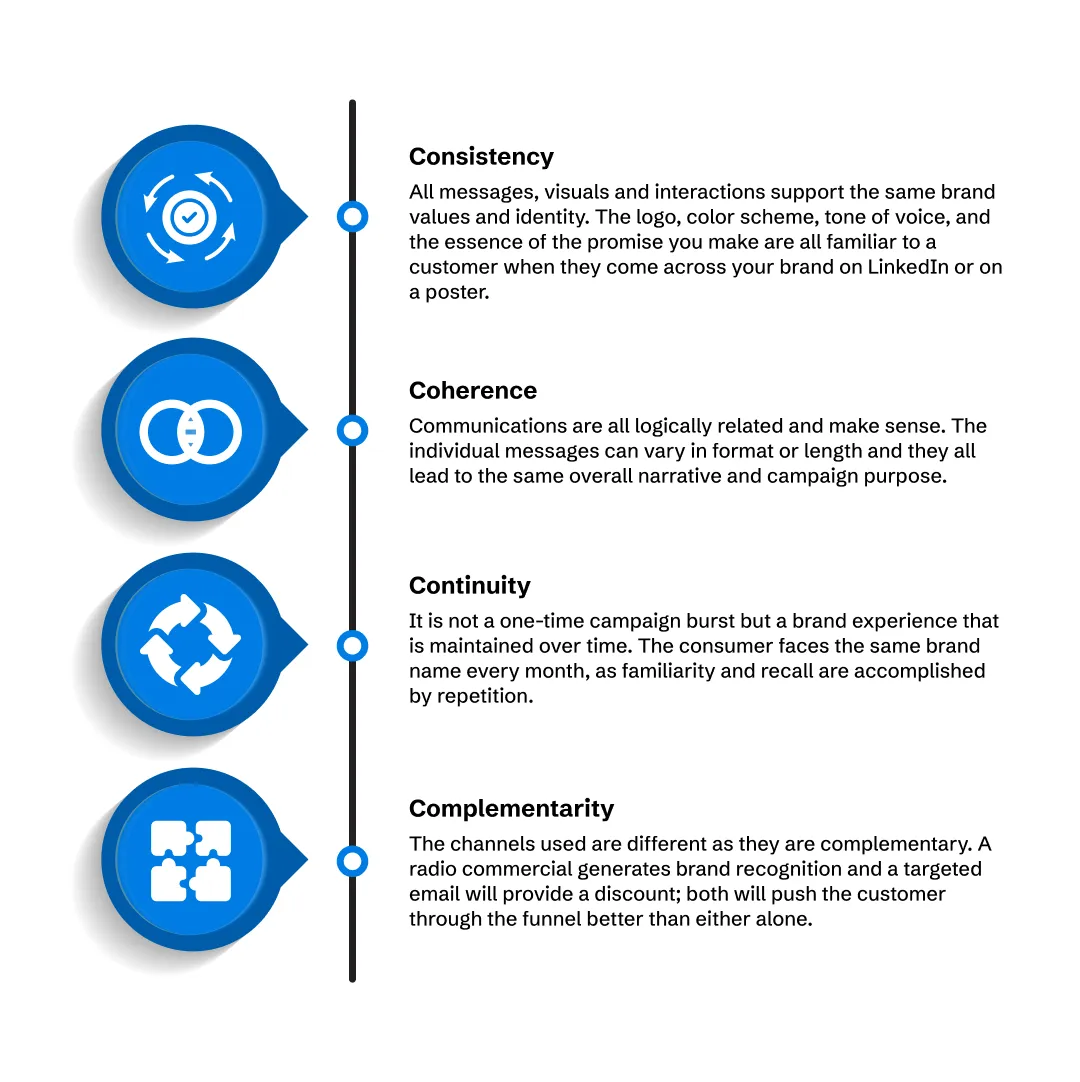
The 4 Cs of integrated marketing are commonly called by practitioners as the basic framework. These principles outline key integrated marketing concepts that make a truly integrated strategy different from mere recycling of content across mediums.
- Consistency: All messages, visuals and interactions support the same brand values and identity. The logo, color scheme, tone of voice, and the essence of the promise you make are all familiar to a customer when they come across your brand on LinkedIn or on a poster.
- Coherence: Communications are all logically related and make sense. The individual messages can vary in format or length and they all lead to the same overall narrative and campaign purpose.
- Continuity: It is not a one-time campaign burst but a brand experience that is maintained over time. The consumer faces the same brand name every month, as familiarity and recall are accomplished by repetition.
- Complementarity: The channels used are different as they are complementary. A radio commercial generates brand recognition and a targeted email will provide a discount; both will push the customer through the funnel better than either alone.
These values are important since the recognition of a brand needs to be repeated, and the trust needs to be reliable. According to Lucidpress, consistent brand presentation across all platforms can increase revenue by up to 23%. With coherent, continuous messaging to customers, there is a much greater likelihood that they will remember and select your brand.
While these principles define how integrated marketing works, it’s equally important to understand where this integration happens within an organization.
Types of Integrated Marketing Communications
Integrated marketing operates on four dimensions, each addressing a different layer of organizational communication.
External (Customer Facing)
This is the most apparent layer: advertising, PR, social media, content marketing, email campaigns, influencer relationships, and events. These are the messages with which customers resonate the most.
Internal (Employee Alignment)
Internal integrated marketing is something which makes sure that each and every team member knows and is able to explain the brand, its values and latest campaigns. This approach uses internal newsletters, training and available brand guidelines.
Horizontal (Cross-Departmental Collaboration)
Horizontal integration dismantles interdepartmental silos. Campaign briefs, customer insights, and message structures are shared across marketing, sales, customer service, and product teams to ensure that all functions strengthen the same experience. This is usually the most difficult aspect to attain and the most effective when accomplished.
Vertical (Alignment with Business Goals)
Vertical integration makes the marketing strategies consistent with the overall business goals like revenue, product strategies and brand positioning. In the absence of this alignment, even campaigns that are well implemented may shift numbers that are not important to the business.
Important elements of Integrated Marketing
It is necessary to coordinate a number of dynamic channels at the same time, in order to build a connected customer experience. The following elements define what makes that integration work.
Multi-Channel Approach: Online and Offline
This integrated approach covers both online channels (social media, SEO, email, PPC, content marketing), and offline channels (print, events, TV, outdoor advertising, direct mail). This is based on which of the above locations your audience is spending their time in, but the experience should present a sense of unity throughout. It is also where integrated online marketing plays a crucial role in aligning digital touchpoints with offline efforts.
Omnichannel Approach: Cohesive Brand Communication
All assets, such as a Google ads or a booth at a trade show, must be in the same visual language: how they use their logo, typeface, color scheme, types of images and tone of voice. This type of marketing ensures that the customers get a connected experience throughout, regardless of the channel they’re viewing.
| You Might Also Like: Best Omnichannel Marketing Tips for Mobile Apps to Follow
Information Compilation and Intermedia Co-ordination
Unified data is one of the strongest but least recognized elements. This is where integrated media planning helps ensure all channels work together with shared insights and attribution models. As a result, you can follow the customer journey more holistically, attribute outcomes effectively, and scale personalization. This unified view ensures every decision is backed by insight rather than assumption.
Collaboration Across Departments
Integrated marketing is not only a marketing department activity. It involves a coordination of marketing, sales, customer service, product and leadership. In a situation where the sales teams share the same messaging framework with the marketing team, the customer experience does not change when sales teams interact with the customer, starting with the initial impression of the ad all the way to the post-sale support interaction.
Once these core components are in place, the next step is understanding how integrated marketing compares to other commonly used approaches.
Integrated Marketing vs. Multichannel & Omnichannel Marketing
While terms like multichannel and omnichannel are often used interchangeably, the differences between them shape how your strategy is executed and experienced by customers.
| Approach | Definition | Focus | Customer Experience |
|---|---|---|---|
| Multichannel Marketing | Being present on multiple channels | Reach and coverage | Channels operate independently; experience may vary |
| Omnichannel Marketing | Seamlessly connecting all channels around the customer journey | Customer continuity | Channels are linked; switching between them is frictionless |
| Integrated Marketing | Unifying all communications — including internal alignment — around a consistent message | Message coherence and brand unity | Every touchpoint feels like the same brand telling the same story |
When to use each:
- Multichannel works when your primary goal is broad reach and you're still learning where your audience lives.
- Omnichannel is ideal for e-commerce and service businesses where customers frequently switch between channels (e.g., browsing on mobile, purchasing on desktop, returning in-store).
- Integrated marketing is the right framework when brand equity, consistent positioning, and long-term customer trust are strategic priorities, which, for most mature brands, is always.
The most effective integrated marketing strategies often incorporate omnichannel execution within an integrated channel marketing framework.
How to Create an Integrated Marketing Strategy?
The following is a stepwise approach that is practical in creating an integrated marketing plan starting with the ground.
Step 1: Establish SMART Goals Relatable to Business Objectives
Start by looking for ways to establish success in the entire marketing landscape. Your targets need to be tied to key business outcomes such as revenue growth, customer acquisition costs, or retention, while being Specific, Measurable, Achievable, Relevant, and Time-bound.
Step 2: Track Your Audience Along the Buying Journey
Getting to know your customers goes beyond mere demographics of your customers. You should learn how they transition out of the discovery stage to the ultimate purchase and record all the obstacles that they encounter during the decision-making process.
It has been found out that knowing their pain points, the channels they use and the habits they have enables you to establish better relationships. By determining their particular triggers of choices and content habits, you can create a journey wherein every new engagement strengthens the preceding one rather than an impression of confusion or redundancy.
Step 3: Clarify the Purpose of Each Channel
Give each channel its own responsibilities rather than attempting to be active in all places. Certain platforms create awareness and others are targeted at the middle or end of the funnel. Brand recognition is usually achieved through social media and display advertisements.
Content marketing and email help people consider their options. Actual sales and returning customers are propelled by CRM tools and support teams. One reason is that the strength of the strategy is the combination of the parts and not the number of different marketing channels that you operate at a given time.
Step 4: Develop One Message on Each Platform
Any successful strategy has a central focal point that is a unified message. The main concept should remain the same although the actual presentation is different in every platform. Although the formats are different, the purpose and mood are identical to make sure that the brand will be well known to all potential buyers no matter where they may view the content.
Step 5: Organize Your Workgroups and Delegate
Integration will not work when your internally-based teams are silent. The same insights and goals are required by marketing, sales, and customer service groups. It implies that you need to assign employees specific channels or campaign tasks to work on and track the progress in relation to your overall business goals with the help of such tools as Asana or Trello. Sharing of tools and frequent meetings can be used to keep everyone on track.
Step 6: Track Data and Decrease Performance
The beginning of the campaign is only the initial step. You are to check not only the channel numbers, but also the outcomes of the whole campaign. Through cross-channel attribution used in analysis, you can determine which touchpoints actually result in sales so that you can decide where to invest your money to give you the best possible return on investment. This information will enable you to improve your strategy as time goes on. The most effective strategies develop in an endless loop of experimentation and trial to enhance outcomes over time.
Examples of Successful Integrated Marketing
Integrated marketing can be considered a fundamental of marketing, given its widespread adoption. Let’s check out some success stories that serve as strong integrated marketing examples across industries.
Coca-Cola's "Share a Coke" Campaign
Introduced in Australia in 2011 and later implemented worldwide, the Share a Coke campaign by Coca-Cola substituted its legendary logo with common first names on the bottles and cans. The campaign was conducted on TV, outdoor, digital, social media, and in store displays, all with the same chat of finding your name and share a Coke with somebody.
The findings were impressive: Coca-Cola experienced a 2 percent growth in sales in the U.S., having lost revenue over a decade, and the campaign received over 500,000 photos posted on social media. Its success was based on the integrated execution, with each channel strengthening the personal, sharable aspect of the product.
The Dove Real Beauty Campaign.
One of the most researched campaigns in the history of integrated marketing is the Real Beauty campaign of Dove, which was launched in 2004. The campaign was a defiance of traditional beauty ideals using billboards, print ads, TV ads, a viral video on YouTube, "Evolution," social media discussions, PR, and in-store communications.
This was all achieved with one provocative question: What is real beauty? Within the first decade of the campaign, Dove increased its sales by 2.5 to 4 billion. The strength of the campaign lay in its consistent message hitting all at once, across the emotional, visual and conversational levels.
Spotify Wrapped
Each year, in December, Spotify challenges millions of personal listening histories with its Wrapped campaign and turns them into unique, data-driven stories that are shareable. The experience is incorporated throughout the Spotify app, push notifications, social media sharing tools, out-of-home advertising in major cities, and wide PR coverage.
The billions of social media impressions that Spotify Wrapped creates organically are due to the personal, visual, and shareable nature of the experience. It is a masterpiece of applying data integration and channel complement to transform customers into brand advocates.
The Future of Integrated Marketing.
The marketing industry is currently rapidly transforming due to a number of market forces.
The First-Party Data and Post-Cookie World.
With the loss of third-party cookies and more restrictive privacy regulations, brands now need to concentrate on the data provided by themselves through their apps, loyalty programs, and email lists in order to ensure that they stay connected to the users. This model produces more effective behavior data by engaging customers directly at different touchpoints.
Personalization at Scale with AI in Marketing
The use of AI in marketing enables brands to make real time modifications in message and timing to each customer. According to a Salesforce study, 73% of individuals desire brands to understand their requirements, and this degree of personalization can be achieved due to these intelligent systems. This provides a means whereby big organizations can engage in one-to-one communication.
Changing Customer Expectations
Gen Z and younger millennials tend to visit numerous sites prior to a purchase and they are extremely low-patience when dealing with a disjointed brand or one that does not demonstrate concern. They desire brands to demonstrate that they are aware of their own values. The outcome is a need for true coherence.
Privacy-Centric Integration
The quality of your own messaging is now a huge competitive aspect since surveillance ads are not working. The outcome of this is that integrated marketing is a more significant matter due to stricter laws on privacy across the globe. Brands that have maintained their positioning and those who have regular viewers will survive in such an environment and the groups that use intrusive advertisements will probably lag to their better-organized rivals.
| Also see: Top Digital Marketing Trends That Will Dominate in 2026
Conclusion
Integrated marketing is not a strategy, but a science. It demands message clarity, consistency, interdepartmental cooperation and organizational determination to dismantle silos. Properly managed, it turns disjointed marketing investment into a compound strategic resource: a brand that consumers know, believe in and come back to.
Brands that succeeded today, be it multinational corporations such as Spotify or challenger brands that created communities of loyalists on their own, are characterized by the desire to integrate. They know that in an infinite channel, attention span world, coherence is money.
Your action plan now should be to review your ongoing marketing campaign. Do you have similar messages on different channels? Is there a common understanding of your brand promise by your sales, marketing, and customer service teams? Do you consider the customer journey as a whole? The responses will give you a clue on where to start.
At its core, integrated marketing means creating one cohesive brand experience instead of fragmented interactions.
Frequently Asked Questions
What is integrated marketing?
Integrated marketing is an approach in which all your marketing channels and communications, social media, email, ads, PR, events and even the pitching of your sales people, all work as one to deliver the same key message and brand experience. Rather than operating isolated campaigns across channels, all is integrated so that the customer is presented with the same, integrated brand narrative across all touchpoints.
What is the difference between integrated marketing and omnichannel marketing?
Omnichannel marketing aims at developing a unified customer experience wherein a customer will alternate channels (e.g., making a purchase on a mobile device and making purchases in the store). Integrated marketing emphasizes message and brand consistency through all channels including alignment within the organization. The strategic framework is integrated marketing; frequently, within the framework, the customer-facing implementation is omnichannel.
What are the key advantages of integrated marketing to small businesses?
Efficiency, since a simple, constant message enables you to reuse the same core content across mediums without having to create a new message each time. Building trust with those who perceive identical verifiable branding on your site, social media, and in-person services will be more apt to trust you. Integrated marketing also assists small groups to concentrate on where to spend scarce resources.
What are some tools that can assist with integrated marketing?
- CRM and Marketing Automation: Salesforce, Marketo, HubSpot.
- Project Management: Asana, Monday.com, Notion.
- Social Media Management: Hootsuite, Sprout Social, Buffer.
- Analytics and Attribution: Google Analytics 4, Northbeam, Triple Whale.
- Klaviyo, Customer Data Platforms: Segment, Twilio.
- Brand Asset Management: Bynder, Canto, Frontify.
- Email Marketing: Mailchimp, Klaviyo, ActiveCampaign.
The right stack is determined by your team size, budget and channel mix, however, the aim of all tools in a combined setup is the same: common data, communication coordination and a consistent brand delivery.

Uncover executable insights, extensive research, and expert opinions in one place.
Related Content