 Here’s a guide to help you understand how web app development can transform your business and keep you ahead of the competition with cutting-edge insights.
The world of business is complex. It's full of challenges, full of opportunities. To thrive, you need strong tools. Reliable tools. For many, these tools are forged through web app development. We have seen businesses falter with inefficient, outdated systems. In parallel, we have seen others operate smoothly, powered by smart, efficient web apps for business.
Take, for instance, Dropbox’s 2023 transformation: a web redesign and AI-powered features streamlined user experience, improved productivity, and reinforced Dropbox’s place in a competitive market.
This is the story of how web application development can shape the way we work, connect, and grow. So if you’re ready to dive into this race by deploying a web app, you need this guide.
Now buckle up, and stay with us until the end!
Benefits of Web App Development for Your Business
A modern business needs robust digital instruments, whether it’s a website or a mobile app, or something even better, a blend of both. Understanding the web development importance for modern businesses is essential when choosing the right digital solution for long-term growth. Business web application is a process to find the middle ground between websites and apps.
Here’s how building a web app helps:
1. Reach More People: The internet offers a vast reach. A web app is your gateway to connect with a wider audience. It works on desktops, laptops, and is often accessed through mobile web browsers. This means more customers can find your brand and use your services.
2. Work Smarter, Not Harder: Good tools simplify work. Custom business website app development can be done to automate tasks, manage inventories, and track sales. This frees up your people to focus on critical thinking, creativity, and customer connections.
3. Better Ties with Customers: Customers value connection. A web app can be a direct line for information, purchases, and support, quickly and easily. This builds trust. Trust is a strong currency. To build it, businesses are using web apps as a great alternative to CRM software, a market which is expected to touch $98.84 billion in 2026.
4. Adaptability in a Changing Market: Business landscapes shift. Markets evolve. A flexible web app lets you adapt. Scale operations when demand is high. Introduce new services. A well-built web app is resilient.
5. Cost-Effective Solutions: Custom solutions might seem like a large initial outlay. However, inefficient tools, lost time, and missed opportunities are more expensive in the long run. Good web app development is an investment. It often yields returns greater than anticipated.

Types and Use Cases of Web Applications
Not all tools serve the same purpose. Some are for highly specific tasks, others for broad functions. Web applications are similarly diverse. Understanding the types of web applications helps you choose the right one for your business needs.
1. Static Web Apps: These are the simplest form, much like a digital brochure. They deliver information. Good for portfolios and basic company sites where content rarely changes. They are easy to build and load quickly.
2. Dynamic Web Apps: These are more complex and interactive. They engage with users. Think of dropshipping sites, social media platforms, and online banking tools They utilize databases and server-side processing, forming the core of modern web apps.
3. E-commerce Applications: The digital storefront. Amazon and Shopify are prime examples of marketplace apps. These are extensive web applications for shopping, handling everything from product displays to secure payment processing. A vital tool for modern retail.
4. Portal Web Apps: These offer a unified point of access to various information and services. University portals for students (courses, grades, news) or healthcare apps are common examples.
5. Content Management Systems (CMS): WordPress is a well-known example. These web apps enable users to create, manage, and modify digital content without extensive coding knowledge.
6. Progressive Web Apps (PWAs): A newer generation, PWAs combine the best features of web and mobile applications. These apps can function offline, send push notifications, and provide an app-like experience within a browser. Many businesses now opt for mobile web app experiences through PWAs due to their reach and user-friendliness.
These are just a few examples. The specific needs of your business will dictate the most suitable type of web application. Many web application projects begin by identifying a clear problem, with the right app type offering the solution.
Future of Web App Development
The technological landscape is always evolving. To stay competitive, you must understand these changes. Here’s what we see on the horizon for web app development:
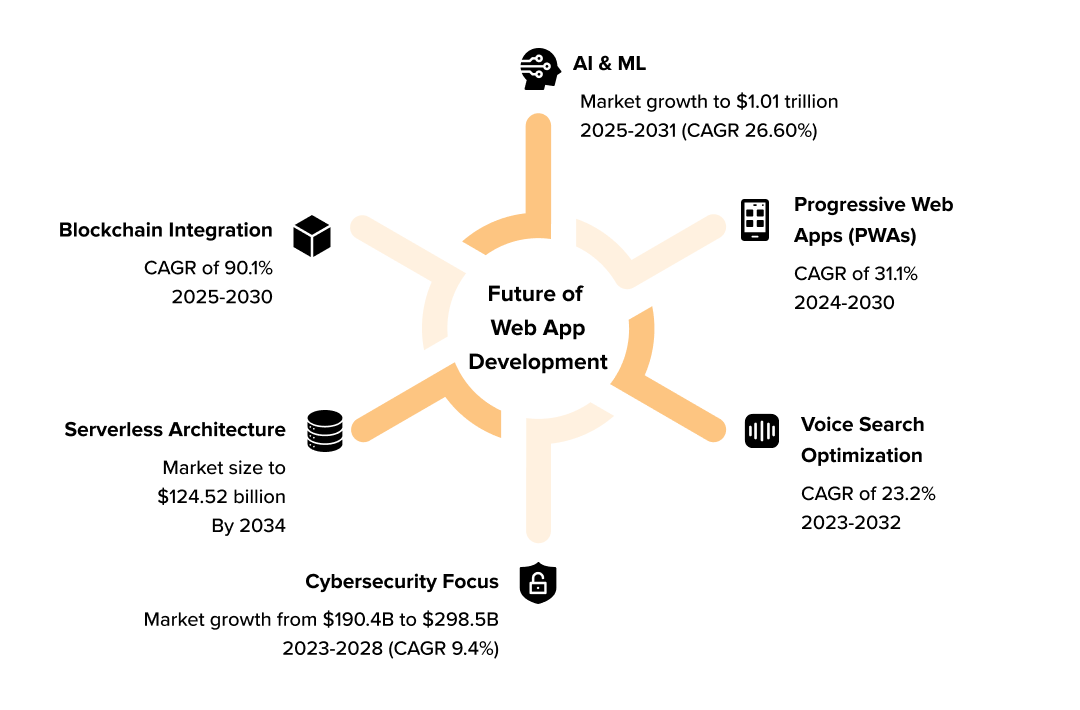
1. Artificial Intelligence (AI) and Machine Learning (ML): AI is a transformative tool. In web apps, this translates to smarter chatbots, personalized user experiences, and enhanced data analysis. The global AI market is experiencing rapid expansion; Statista projects revenues in the AI market to record a compound annual growth rate (CAGR 2026-2031) of 26.60%, resulting in a market volume of $1.01 trillion by 2031. This growth will profoundly impact modern web apps. Many examples of AI being used for app personalizations already exist in the market, a direction in which ai web development companies are also rapidly innovating. For instance, Grammarly, Duolingo, etc.
2. Progressive Web Apps (PWAs) Will Gain More Traction: As mentioned, PWAs offer an excellent user experience, offline capabilities, and independence from app stores, making them highly attractive. Businesses want to connect with users effectively, and PWAs facilitate this. As a result, the PWA market is rising at a CAGR of 31.1% between 2024 and 2030.
3. Voice Search Optimization: Voice interaction with devices is increasing. "Hey Google, find a local service." Web apps must be designed to understand and respond to voice commands, emphasizing use cases of natural language processing. As businesses worldwide are identifying and expanding NLP applications, the market size is rising at a CAGR of 23.2% between 2023 and 2032.
4. Cybersecurity Focus: Robust applications need strong defenses. As web apps manage more sensitive data, security becomes critical. Expect more advanced security features, encryption, and authentication methods to become standard in custom business web app development. With the rising need for cybersecurity standards, the global cybersecurity market is projected to grow from $190.4 billion in 2023 to $298.5 billion by 2028. That’s a CAGR of 9.4%.
5. Serverless Architecture: This model allows developers to build and run applications without directly managing server infrastructure, potentially reducing costs and improving scalability. It’s efficient, like having resources available precisely when needed. As more web developers worldwide adopt the model, its market size is rising to reach a tentative value of $124.52 billion by 2034.
6. Blockchain Integration: Beyond digital currencies, blockchain offers secure, decentralized methods for managing data and transactions. Potential applications include supply chain management, digital identity verification, and secure voting systems within web apps. Grand View Research reported that the global blockchain technology market size is expected to rise at a CAGR of 90.1% between 2026 and 2030.
These trends point towards a future where web apps for business are smarter, faster, more secure, and deeply integrated into operations. Selecting the right web development frameworks will be crucial for creating these next-generation applications. For businesses looking to build such solutions, partnering with experienced web development companies is a prudent approach.
Challenges & Limitations of Web Application Development
No project is without its hurdles. Even the best-planned web application can encounter obstacles. For instance:
1. Security Risks: Powerful tools require careful handling. Web apps can be targets for cyberattacks. Continuous vigilance, regular updates, and robust security protocols are indispensable. Leverage AI in cybersecurity helps as well.
2. Complexity of Development: Building a feature-rich, reliable business web application is not a simple task. It demands skilled developers, meticulous planning, and comprehensive testing. This is where many web application projects can face difficulties if not managed effectively.
3. Integration with Existing Systems: Many businesses operate with legacy systems. Ensuring a new web app communicates seamlessly with older software can be challenging, requiring careful planning and execution.
4. Keeping Up with Technology: The digital realm evolves rapidly. Today's innovations can become tomorrow's standards. Continuous learning and adaptation, including updating web development frameworks and tools, are vital.
5. User Experience (UX) Demands: The role of UI/UX design in web experiences is very critical, as users’ expectations are rapidly evolving. A clunky, slow, or confusing web app will likely be abandoned. Prioritizing good UX design is critical and an ongoing commitment.
6. Browser Compatibility: Different web browsers can sometimes render or execute web apps differently. Thorough testing across multiple browsers and devices is crucial to ensure a consistent user experience.
Understanding these challenges allows for better preparation. It helps in selecting the right team, the appropriate technologies, and a sound strategy.

Conclusion: The Core Engine of Modern Business
The dynamics of commerce are demanding. They push businesses in many directions. But with the right digital tools, you can effectively manage your operations and growth. Web app development provides these tools.
It builds the core engines that power modern business solutions. From connecting with customers globally to making your internal processes smoother, faster, and more efficient, web and application development is no longer a mere option. It is a fundamental necessity.
It helps your business innovate, grow, and succeed. The market is vast and competitive, but with a well-crafted web app, you are better equipped to achieve your business objectives.
Frequently Asked Questions
How do you develop a web application?
Developing a web application is a structured process:
1. Define Your Idea & Goals: What problem will the application solve? Who is the target audience? What are the desired outcomes? A clear vision is essential.
2. Plan & Research: Analyze the market and competitors. Define specific features and functionalities. Create user flows and wireframes to map out the user journey.
3. Choose Your Technology Stack: Select appropriate programming languages (e.g., Python, Ruby, JavaScript), frameworks (e.g., React, Angular, Vue.js for front-end; Django, Ruby on Rails, Node.js for back-end), and databases. Consulting with expert web development companies can be beneficial here.
4. Design the User Interface (UI) and User Experience (UX): Focus on creating an aesthetically pleasing and intuitive interface. This is how users will interact with your application.
5. Develop the Application: This is the coding phase, encompassing both front-end (client-side) and back-end (server-side) development.
6. Test Thoroughly: Conduct comprehensive testing for bugs, performance issues, security vulnerabilities, and usability across various devices and browsers.
7. Deploy: Launch the web application on a server, making it accessible to users.
8. Maintain & Update: Post-launch, monitor performance, address any emerging issues, and implement updates or new features based on user feedback and evolving business needs. This is crucial for all modern web apps.
What are the main types of web applications?
The primary types include static web apps, dynamic web apps, e-commerce applications, portal web apps, content management systems (CMS), and progressive web apps. The most suitable type depends on your specific business requirements and goals.
Why are web apps important for business?
Web apps are crucial for businesses to enhance efficiency, improve customer engagement, expand their reach, streamline operations, and gain a competitive advantage in the digital marketplace. A strategic business website app development approach can significantly transform business processes.
What are some key web development frameworks?
Popular front-end frameworks include React, Angular, and Vue.js. For back-end development, common choices are Django (Python), Ruby on Rails (Ruby), Express.js (Node.js), and Spring (Java). The selection depends on project requirements, scalability needs, and the development team's expertise.
How do I choose a good web development company?
Look for a company with experience relevant to your industry and project scope. Review their portfolio and case studies. Seek client testimonials or references. Discuss their development methodology and communication practices.
Ensure they demonstrate an understanding of your business objectives, not just the technical specifications. MobileAppDaily.com features directories and reviews that can assist in finding reputable web development companies.
How much does it cost to build a web app?
It depends on the app’s complexity. A simple web app might cost $15,000–$25,000, while a complex one with advanced features can range from $80,000 to $200,000 or more. Factors like design, features, and the development team's rates affect the cost.
How many hours does it take to build a web app?
On average, a basic web app takes 400–800 hours. A more complex app can take 1,200–2,000+ hours. The timeline varies based on features, design needs, and team size.
What are the 7 stages of web app development?
- Planning: Define goals, scope, and requirements.
- Research: Analyze users, market, and tech needs.
- Design: Create wireframes and UI/UX layouts.
- Development: Code the front-end and back-end.
- Testing: Check for bugs and functionality.
- Deployment: Launch the app on a server.
- Maintenance: Update and improve the app over time.

Uncover executable insights, extensive research, and expert opinions in one place.
Related Content